
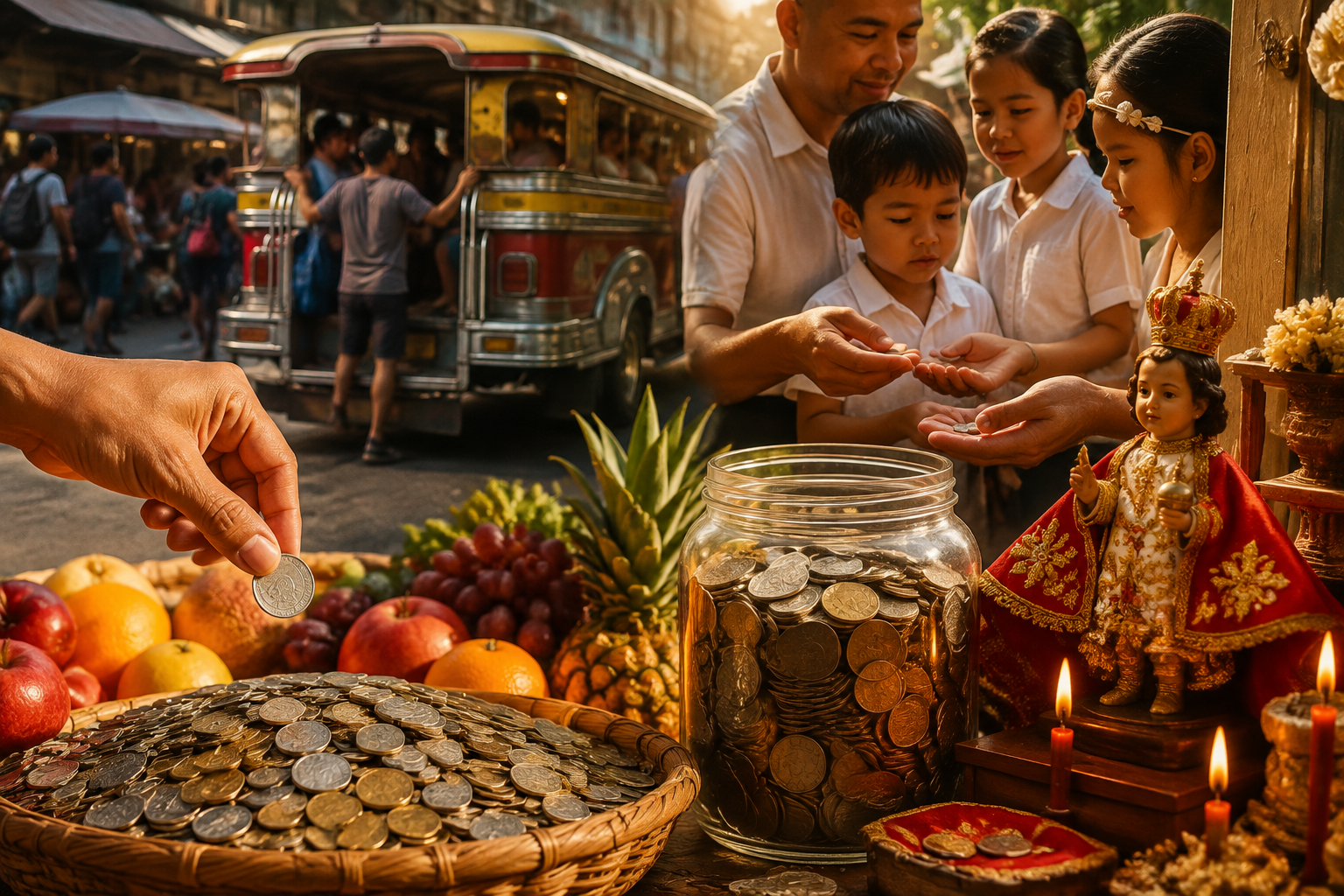
In the Philippines, the clink of coins dropped into a jeepney’s fare box is a sound woven into daily life. Yet behind this mundane transaction lies a complex cultural architecture that dictates how Filipinos select, keep, and circulate their barya. While the Bangko Sentral ng Pilipinas (BSP) accelerates its digital payments roadmap, social customs and deep-seated beliefs are quietly shaping a parallel coin economy—one that doesn’t always align with monetary policy.
The Superstitious Heart of Coin Hoarding
For millions of Filipino households, coins are not merely petty cash. They are talismans. The belief that a coin-laden pocket or wallet attracts more wealth—“ang pera ay dumadami kapag may kasamang barya”—drives people to deliberately keep specific denominations at hand. During New Year celebrations, families fill bowls with 12 different round fruits and scatter coins on tables and windowsills, a ritual called pamalit meant to invite prosperity. Many of those coins never return to circulation. They are carefully stored in red envelopes or altar boxes, becoming permanent fixtures in domestic spirituality.
This superstition is reinforced by the practice of placing coins under the foundations of new homes or inside business cash registers. The chosen coins are almost always the gleaming, gold-colored 5-piso and 10-piso pieces, perceived as more potent than smaller centavo coins. A sari-sari store owner in Tondo will readily explain that the 5-piso coin bearing the face of Andres Bonifacio carries a revolutionary energy that wards off business failure—an interpretation that turns legal tender into a culturally coded asset.
Coins in Rites of Passage and Daily Rituals
Beyond superstition, coins are deeply embedded in Filipino life-cycle events. At weddings, sponsors drop 25-centavo and 1-piso coins into the couple’s palms during the arras ceremony to symbolize shared responsibility. Baptisms, graduations, and even barangay fiestas see coins pressed into the hands of children by elders as aguinaldo. These gifted coins are seldom spent; they are tucked into piggy banks or passed down as pamana—family heirlooms that carry the giver’s blessing. A 2026 survey by the National Commission for Culture and the Arts noted that 67% of respondents in rural Luzon keep a “lucky coin” received from a grandparent, regardless of its purchasing power.
The daily devotion to the Santo Niño also funnels coins out of the cash economy. During the Sinulog Festival and in countless home altars, devotees offer 1-piso and 5-piso coins as panata (vows). Parishes regularly collect sacks of these offerings, but a significant portion remains in private shrines. According to the BSP’s Coin Recirculation Report released in February 2026, an estimated 24% of all minted Philippine coins are idle in jars, altars, and children’s alkansya, a figure that has risen by 6 percentage points since 2023. The report explicitly cites “cultural hoarding” as a primary obstacle to efficient coin circulation.
The Digital Divide and the Persistent Coin Economy
While GCash and Maya transactions dominate urban centers, the coin economy thrives in the informal sector where cash is still king. Public market vendors, tricycle drivers, and street food hawkers rely on precise coin change to maintain razor-thin margins. In these micro-economies, the choice of coin is tactical: the 5-piso piece is preferred for its weight and recognizability, while the 1-piso coin remains the bedrock of piso fare top-ups for short jeepney rides. Despite the proliferation of QR codes, a 2026 Pulse Asia survey found that 58% of micro-entrepreneurs in Class D and E communities still use physical coins for at least half of their daily transactions.
This endurance is also tied to a uniquely Filipino social norm: palabra de honor in small debts. Neighbors borrowing a sachet of shampoo or a cup of rice often repay in coins—specifically the 1-piso and 5-piso denominations—as a tangible marker of goodwill. The ritual of handing over a coin, rather than sending a digital peso, preserves the personal connection that digitized payments lack. It is a gesture that says the debt is settled, not just financially, but socially.
BSP’s 2026 Push to Recirculate the Hidden Barya
Recognizing the cultural grip on coins, the BSP has shifted from pure enforcement to culturally attuned campaigns. The 2026 “Barya Balik Eskwela” drive partners with schools and parishes to encourage children to exchange hoarded coins for school supplies, a strategy that respects the saving habit while injecting idle currency back into circulation. Yet the campaign’s success is uneven. As reported by the Philippine Daily Inquirer in March 2026, the BSP recovered over 300 million coins in the first quarter alone, yet regional BSP offices noted that families often set aside “special coins” before surrendering their jars, preserving the sentimental core that regulations cannot easily penetrate.
The result is a fascinating duality: the same nation that adopted the QR Ph code for instant payments still treats the 5-piso piece as a vessel of ancestral blessing. As the BSP prepares to introduce a new coin series, the question isn’t just about metal composition or anti-counterfeiting features. It’s about whether any redesign can compete with the weight of tradition that Filipinos have already minted into their currency.