
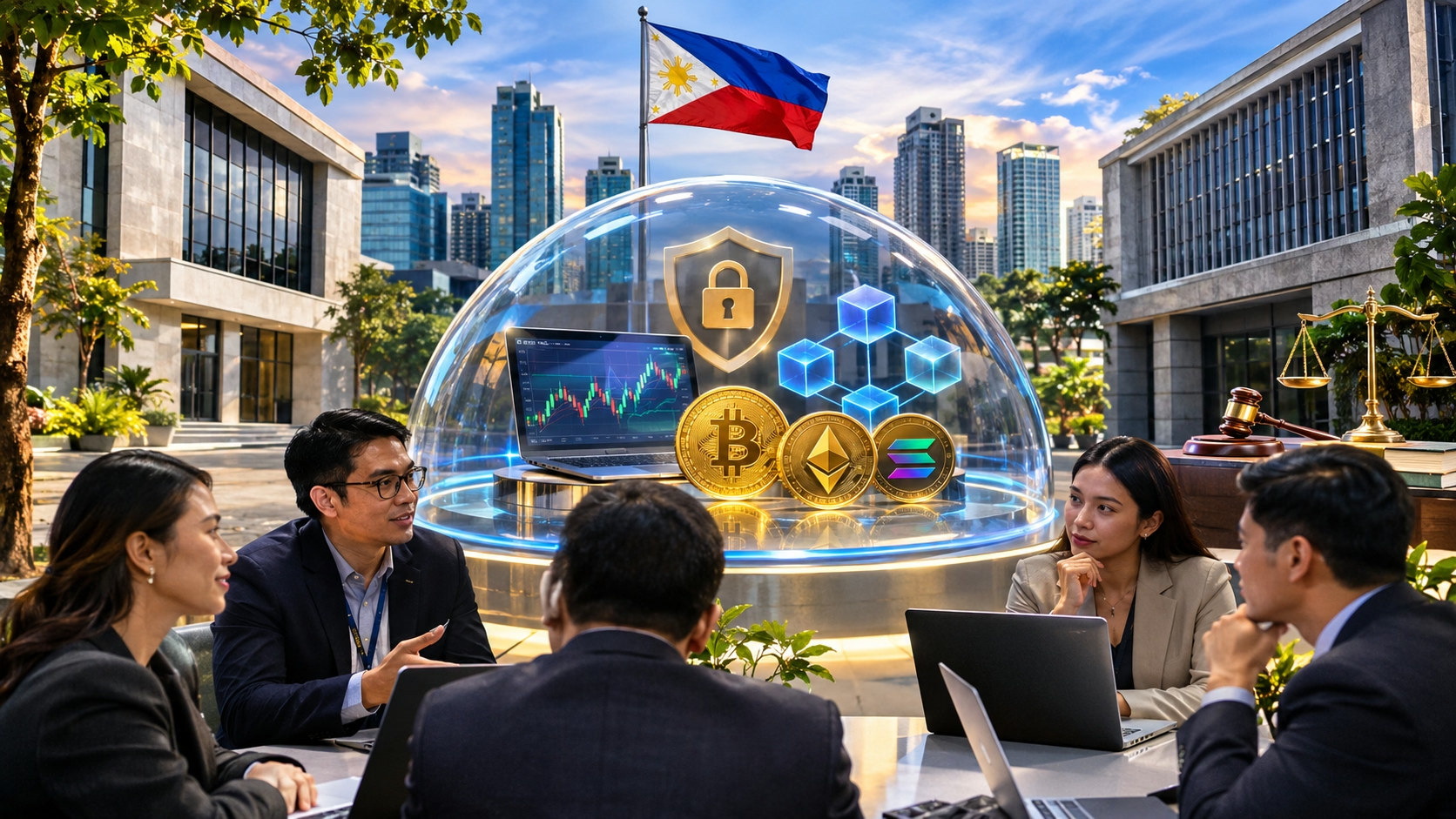
The Philippines has quietly built one of Southeast Asia’s most structured—and most misunderstood—regulatory testing grounds for digital assets. At the center of it sits the Securities and Exchange Commission’s Strategic Regulatory Sandbox, known as StratBox, a framework designed to let novel crypto products and business models operate in a live environment under close supervision. But the Philippine model is not a single sandbox. It is a dual-regulator architecture in which the SEC and the Bangko Sentral ng Pilipinas (BSP) draw distinct jurisdictional lines, and participants must learn to navigate both.
The Dual-Regulator Architecture Behind the Sandbox
The SEC regulates crypto asset exchanges and crypto asset service providers (CASPs), while the BSP oversees virtual asset service providers (VASPs) and any activity involving fiat currency movement, including peso-to-crypto conversions. This division is not cosmetic. It determines what a sandbox participant can legally do, what it cannot do, and which license it must hold before a single user is onboarded.
The BSP’s Circular No. 1108 requires a VASP license for entities handling crypto-to-fiat services, and a moratorium on new VASP licenses has been in place since September 2025. The SEC, meanwhile, introduced CASP rules in July 2025, mandating registration and operational transparency for crypto platforms. The sandbox sits at the intersection of these two regimes, but it does not merge them.
The StratBox in Practice: The Binance–BlockShoals Case
The most closely watched test of the framework is the partnership between global exchange Binance and Philippine-incorporated fintech BlockShoals Technologies Inc. In November 2025, BlockShoals received in-principle approval from the SEC to join StratBox as a Crypto Asset Intermediary; a Notice to Proceed followed in April 2026, and final authorization to begin testing was granted in July 2026. Under the approved structure, BlockShoals connects local users to Binance’s global platform, with Binance acting as the global CASP partner.
The arrangement is deliberately narrow. BlockShoals must complete a 90-day system integration phase with a BSP-licensed local VASP before live testing can begin, and even then, the sandbox does not permit peso transactions. “Binance and BlockShoals are not moving pesos, which is clearly under the BSP’s jurisdiction,” BlockShoals’ head of legal, Marie Antonette Quiogue, said at Philippine Blockchain Week 2026. The BSP has been equally direct: neither Binance nor BlockShoals holds a VASP license, and “participation in the regulatory sandbox does not exempt an entity from complying with applicable laws, including licensing requirements”.
Sandbox Entry Is Not a Shortcut to Approval
The SEC has moved to correct a persistent misconception: admission to StratBox is not a guarantee of eventual full authorization, nor does it immunize a participant from penalties for prior securities-law violations. “Being in the sandbox does not cure the penalties that will be imposed on a company that had committed violations against the Securities Regulation Code,” SEC Commissioner Rogelio V. Quevedo said in August 2026. “It’s not simply a highway to being approved already by the SEC. It’s just there so that the SEC can properly evaluate”.
SEC Chairperson Francisco Ed. Lim framed the sandbox as a data-gathering exercise rather than a rubber stamp. “We do not approve innovation only because there is an issue. Neither do we reject it because it is unfamiliar,” Lim said, adding that the regulator will examine the data and determine the appropriate regulatory framework before deciding whether an innovation should proceed. The SEC has also signaled that tokenization—including tokenized shares—is among the next areas it may explore through the sandbox.
Why the Philippine Model Matters for Digital Asset Business Models
For founders and global platforms, the Philippine sandbox offers something rare: a regulated path to market entry after a period of exclusion, but on terms that preserve consumer protection and regulatory oversight. Binance’s Philippine general manager, Jen Bilango, has described the compliance work as a template: “Binance’s heavy lifting in compliance today will ultimately establish the standard that allows other global exchanges to legally and safely operate in the Philippines in the future”. BlockShoals is also exploring tokenized securities and bonds with local issuers, and has adopted a tiered product-access model that matches complexity with customer knowledge tests.
The framework is still evolving, and its two-year testing window means the real verdict on these business models will come from operational data, not from the approval announcement. But the Philippine experiment already offers a clear lesson: a sandbox is most useful not when it lowers standards, but when it makes the rules of the road visible before the traffic arrives. For a detailed legal overview of the Philippine fintech and sandbox landscape, the Fintech Laws and Regulations 2026 – Philippines chapter published by Global Legal Insights provides a current and authoritative reference.