
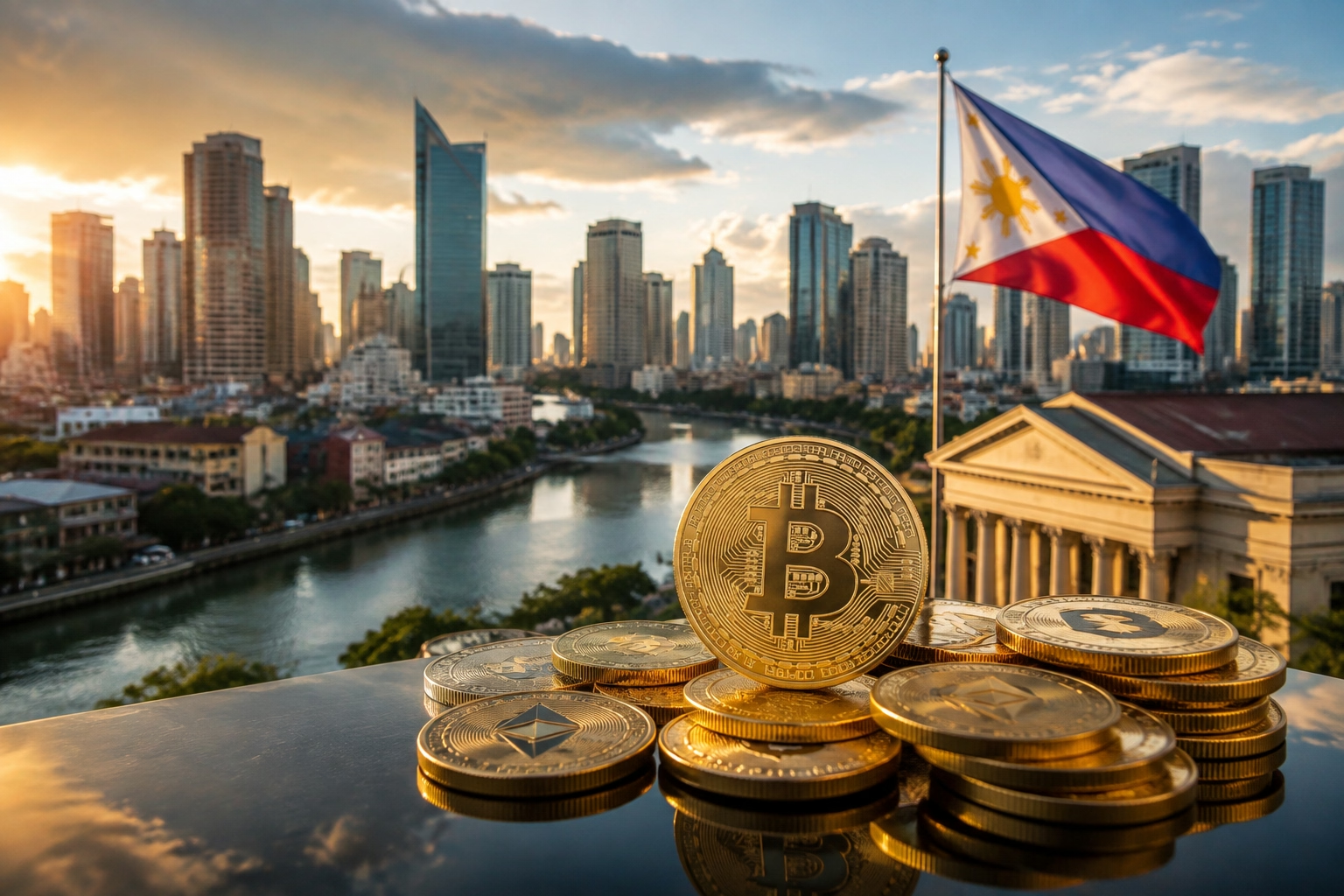
The Philippine cryptocurrency market has long been a paradox—a hotbed of grassroots adoption driven by play-to-earn gaming yet constrained by regulatory ambiguity. As we navigate 2026, this narrative has shifted dramatically. The government, through the Bangko Sentral ng Pilipinas (BSP) and the Securities and Exchange Commission (SEC), has moved from a stance of passive observation to active, structured oversight. This transition is not merely about compliance; it is fundamentally reshaping liquidity, investor demographics, and the operational viability of exchanges operating within the archipelago.
The Institutionalization of Digital Assets
The most significant shift in 2026 is the full implementation of the regulatory sandbox framework introduced in late 2025. The BSP has utilized this framework to test and subsequently authorize Peso-backed stablecoins for commercial use. This is a game-changer for the local market.
Previously, Filipino traders faced high friction costs converting PHP to USDT or USDC, often relying on peer-to-peer (P2P) markets that were susceptible to fraud. In 2026, with BSP-approved banks now issuing regulated stablecoins, the volatility risk associated with foreign exchange is mitigated. This has led to a surge in institutional liquidity.
According to the BSP’s Digital Payments Transformation Roadmap and recent circulars, the central bank has mandated that all Virtual Asset Service Providers (VASPs) must hold a minimum capital requirement and segregate corporate funds from client assets. You can review the official guidelines on the BSP Official Website regarding Virtual Assets to see how these rulings are enforcing operational transparency.
Tax Clarity: From Gray Area to White Market
For years, the Bureau of Internal Revenue (BIR) struggled to tax crypto transactions due to the pseudo-anonymous nature of blockchain. In 2026, the government has solved this by integrating tax reporting directly into the transaction layer of registered exchanges.
Under the new regulations, all gains from crypto trading are treated as capital gains, with a flat rate applied at the source. While some traders lament the reduction in profit margins, this clarity has attracted a different kind of capital: foreign direct investment (FDI). International liquidity providers, previously scared off by the threat of retroactive tax claims, are now entering the Philippine market. They view the clear tax framework as a lesser evil compared to the legal uncertainty of operating in other Southeast Asian nations.
Impact on Play-to-Earn and Remittances
The regulations are also curtailing the “wild west” era of NFT gaming. Game developers must now register their tokens with the SEC if they function as securities. This has led to a consolidation in the gaming sector, filtering out bad actors.
However, the most profound socio-economic impact is on remittances. With BSP-sanctioned stablecoins now available, Overseas Filipino Workers (OFWs) can send money home with fees reduced by up to 70% compared to traditional wire transfers. The government’s regulation of this space has legitimized crypto as a remittance tool, ensuring that the billions of dollars flowing into the country annually are done through compliant, trackable channels.
Consumer Protection and Market Stability
The 2026 regulations are characterized by a heavy emphasis on cyber-hygiene. The BSP has introduced a “Liability Guarantee Fund” requirement for major exchanges. In the event of a hack or smart contract failure, users are guaranteed reimbursement up to a specific threshold. This is a direct response to the high-profile exploits that plagued the region in 2023 and 2024.
Exchanges operating in the Philippines must now undergo third-party audits regarding their cold storage reserves. This has forced several smaller, under-capitalized exchanges to exit the market, resulting in an oligopoly where only the most secure platforms dominate. While this reduces competition, it significantly lowers the risk profile for the average Filipino investor.
The Rise of Real-World Asset (RWA) Tokenization
With the legal groundwork established, 2026 has seen an explosion in the tokenization of real-world assets (RWAs). The Philippine Stock Exchange (PSE) has engaged in discussions regarding the listing of tokenized bonds.
Regulations now allow for the fractional ownership of real estate via blockchain tokens. This is a specific regulation that allows middle-class Filipinos to invest in high-value property in Metro Manila and Cebu with as little as ₱5,000. This has democratized access to investment vehicles that were historically reserved for the ultra-wealthy, directly influencing the diversification of the local crypto portfolio beyond mere speculation.
Challenges in Enforcement
Despite the progress, the impact of these regulations is not without friction. The “decentralized” ethos of crypto is being tested. Decentralized Finance (DeFi) protocols that do not have a central authority face a deadline to register or face ISP blocking. This has sparked debates regarding the feasibility of regulating code. The government is walking a tightrope between protecting citizens and stifling innovation, making 2026 a pivotal year for how emerging markets balance regulation with technological freedom.