
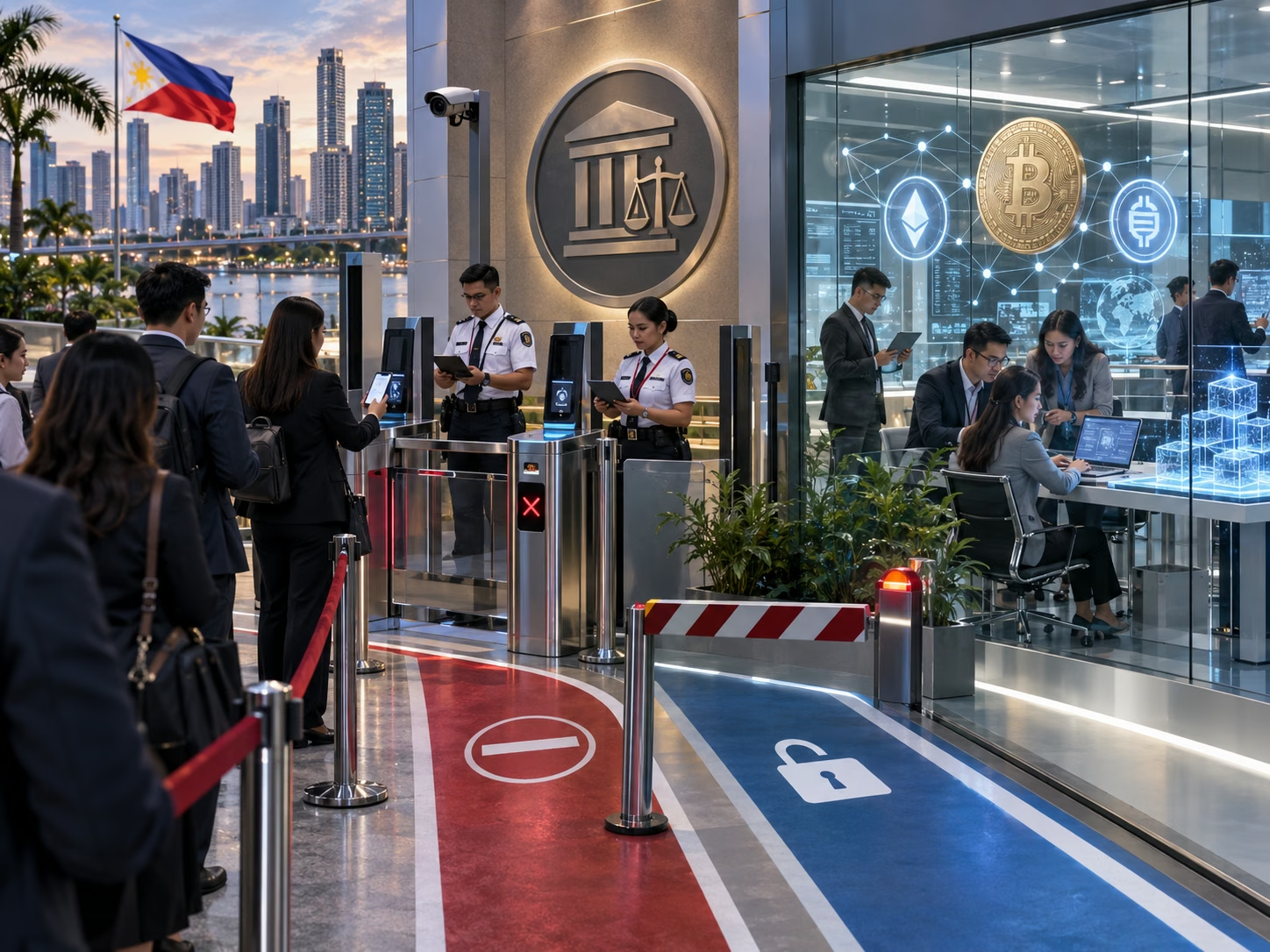
The Philippines has emerged as one of Southeast Asia’s most closely watched crypto regulatory laboratories in 2026. With the Bangko Sentral ng Pilipinas (BSP) and the Securities and Exchange Commission (SEC) operating parallel yet distinct oversight tracks, the country’s enforcement posture has shifted from passive monitoring to active structural tightening.
The BSP’s Licensing Gatekeeping and the Circular No. 1108 Framework
Under BSP Circular No. 1108, any entity facilitating crypto transactions for Philippine residents must secure a Certificate of Authority as a Virtual Asset Service Provider (VASP). The central bank has reinforced this requirement throughout 2026, issuing public advisories warning Filipinos against unauthorized VASPs and collaborating with the SEC, National Telecommunications Commission, and private sector partners to conduct market surveillance.
In May 2026, the BSP published a formal warning listing risks associated with unlicensed platforms, including loss of funds through fraud, lack of legal recourse, and restrictions resulting from government enforcement actions. The regulator simultaneously directed supervised financial institutions to deal only with appropriately authorized virtual asset businesses, effectively cutting off banking rails for non-compliant operators.
SEC’s Sandbox Strategy: Controlled Innovation with Boundaries
The SEC has taken a parallel but methodologically different approach. In 2026, the Commission advanced its Strategic Regulatory Sandbox (StratBox) framework, granting BlockShoals Technologies Inc. approval to test Binance-linked services under a controlled environment. SEC Chair Francis Lim emphasized that sandbox admission does not equal approval: “We do not approve innovation only because it is new; neither do we reject it because it is unfamiliar”.
SEC Commissioner Rogelio Quevedo clarified that sandbox participation “does not cure the penalties that will be imposed on a company that has committed violations against the Securities Regulation Code”. The sandbox framework, introduced in mid-2025, also accommodates real-world asset tokenization, with four companies—including a tokenized real estate project—advancing through testing.
Binance’s Conditional Re-Entry and the Peso Boundary
Binance’s return to the Philippine market illustrates the practical friction of dual regulation. While the exchange now offers crypto trading through BlockShoals under the SEC’s CASP framework, both entities remain barred from handling Philippine peso transactions due to lacking BSP VASP licenses. A legal adviser for BlockShoals explained that “trading falls under the SEC’s jurisdiction, and Binance and BlockShoals are not handling pesos, which clearly falls under the BSP”.
This jurisdictional split creates a fragmented user experience: Filipino traders can access Binance’s global platform but must rely on alternative channels for peso-related services.
The Proposed 12-Month Payment Operator Freeze
In September 2026, the BSP proposed a 12-month suspension on new Operators of Payment Systems (OPS) registrations to conduct a comprehensive review of its classification and licensing framework. Applications submitted before the suspension would be processed but neither approved nor rejected until the moratorium ends.
The draft circular also introduces stricter controls on payment arrangements involving VASPs. BSP-supervised institutions providing merchant acquisition services would be required to establish direct agreements with regulated VASP clients, subject to enhanced due diligence, transaction and settlement limits, and risk-based monitoring. Critically, VASPs are now categorized alongside gambling firms, gaming service providers, adult-content companies, and money remittance services for heightened scrutiny.
Enforcement Trajectory: Registration Tightening Meets Innovation Testing
The Philippines’ 2026 regulatory posture reflects a deliberate two-track strategy: the BSP constricts market entry through licensing bottlenecks and high-risk classification, while the SEC tests innovation within bounded sandboxes. As of September 2026, the BSP’s proposed freeze remains open for public comment and has not yet been finalized. For market participants, the message is unambiguous: compliance with both BSP and SEC frameworks is the only viable path to sustainable operations.