
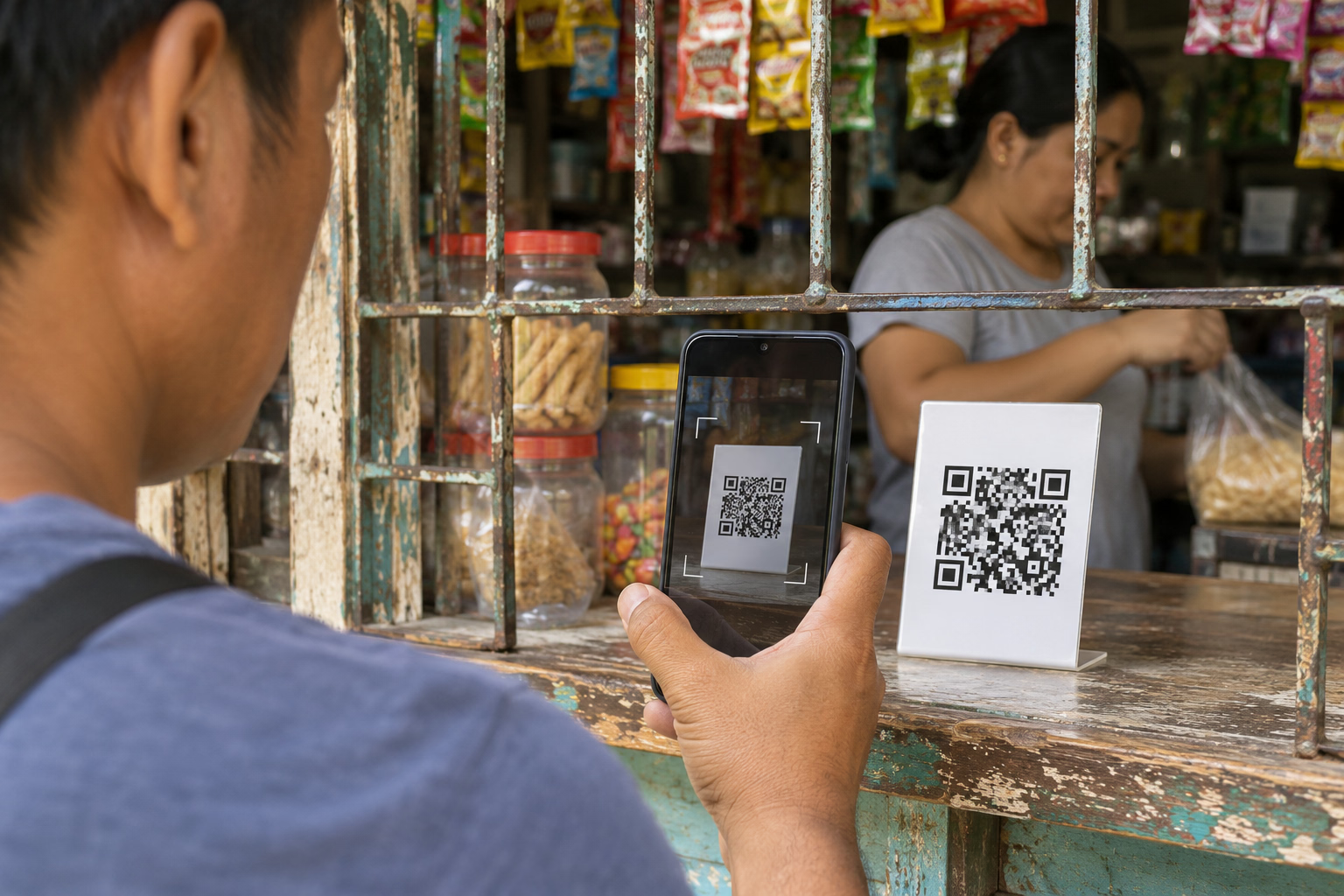
The Philippine money mule is changing shape. What used to look like a student selling access to a savings account for a few thousand pesos now resembles a small business with a QR code, a merchant account, and a crypto off-ramp. That evolution matters because every scam, regardless of how it starts, ends at an account—a regulated touchpoint where stolen money is received, layered, and eventually converted into cryptocurrency or withdrawn.
From Rented Accounts to “Mule Merchants”
The classic mule model relies on ordinary people handing over login credentials, SIM cards, and sometimes entire phones after answering a part-time job post or a “commission” offer in a group chat. The syndicate then controls an account that has already passed identity checks. When one account is flagged, it is replaced.
But a personal account receiving dozens of transfers from strangers eventually looks anomalous. A merchant account does not. A sari-sari store, an online seller, or a QR-enabled stall is expected to collect many small payments from people it has never met—which is exactly what laundering traffic resembles. The Bangko Sentral ng Pilipinas flagged this in May 2026 through Memorandum M-2026-017, warning specifically about “mule merchants” whose QR codes are used by others to receive and disguise illicit funds.
The Crypto Hop: Where Wallets Enter the Chain
The mule account is rarely the final destination. Investigators describe each transfer as a hop: bank account to e-wallet, e-wallet to a money service business, then to a virtual asset service provider and private wallets to maximize transactional distance from the source. The Anti-Money Laundering Council has documented exactly this layering pattern in a 2026 freeze order covering 25 virtual asset wallets and 86 bank accounts tied to a flood-control plunder probe. Transactions reportedly moved ₱50 million to ₱100 million at a time into digital assets, using intermediaries, corporations, remittance channels, and VASPs to obscure the trail.
What makes the crypto hop attractive is speed and fragmentation. Since many banks made InstaPay and PESONet transfers free under Circular 1238, breaking a large sum into many small transfers across multiple accounts costs almost nothing. The friction that once slowed laundering has largely disappeared; only detection remains.
The Scale: P603 Billion in Modeled Exposure
The mule economy is not a niche problem. A 2026 white paper by IDfy Philippines and CIBI Information Inc., examining 2025 payment data, estimated P603 billion in annual fraud exposure linked to money mule accounts—a modeled figure derived from P24.74 trillion in PESONet and InstaPay transactions and a 55.4 percent scam-related factor. The same study notes that mule networks thrive because ordinary citizens often do not realize they are being exploited until it is too late.
Regulators are responding. The Anti-Financial Account Scamming Act criminalizes mule account use, with penalties reaching 14 years imprisonment or fines up to ₱5 million. The BSP has also tightened VASP due diligence, requiring supervised institutions to transact only with registered or authorized virtual asset providers and to continuously monitor for unusual fund movements.
A Real 2026 Case: When Crypto Wallets Become the Laundry
The AMLC’s September 2026 freeze order is the clearest recent illustration of how bank accounts and wallets work together. The Court of Appeals covered 86 bank accounts, four investment accounts, one insurance policy, and 25 virtual asset wallets associated with a lawmaker and linked entities. Investigators found no legitimate operating revenues to justify the scale of investments, and traced kickback proceeds through individual intermediaries, corporations, commercial banks, money service businesses, and VASPs. The case shows that identifying a wallet or account is only the beginning; the chain itself—bank account → corporation → intermediary → MSB → VASP → wallet → second wallet—is the real investigative target.
For banks, fintechs, and crypto platforms in the Philippines, the question is no longer how many hours they have to stop a transfer. It is how many hops they can trace before the money becomes another wallet in another jurisdiction.