
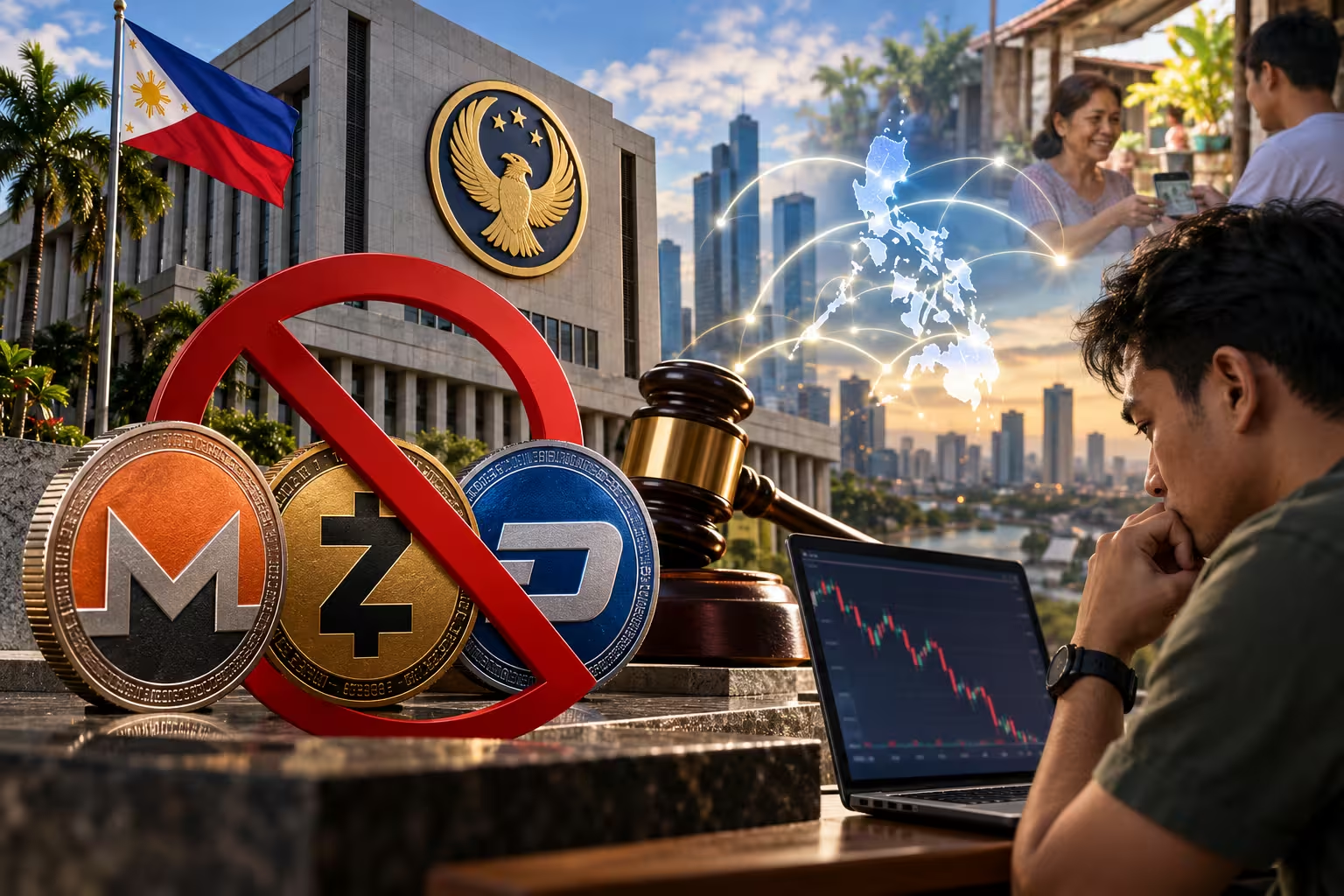
The Bangko Sentral ng Pilipinas (BSP) has drawn one of Southeast Asia’s hardest lines yet against financial anonymity in crypto. Through Memorandum No. M-2026-023, approved on 5 June 2026, the central bank barred every licensed Virtual Asset Service Provider (VASP) in the country from listing or supporting “anonymity-enhancing virtual assets”—the category that includes Monero, Zcash, and Dash. The directive reaches Coins.ph, PDAX, and every registered VASP operating in the Philippine market, forcing an immediate reconfiguration of token menus and trading access for retail users.
The Regulatory Shockwave: What M-2026-023 Actually Says
The memorandum is not a narrow prohibition buried inside broader guidance. It makes the privacy-coin ban a core licensing condition, while simultaneously raising the bar for every token a regulated platform offers. VASPs must now run a six-pillar pre-listing assessment covering issuer background, market maturity, use cases, transparency and traceability, redemption and reserve structures, and legal and regulatory compliance. For asset-backed and fiat-backed tokens, the BSP adds a “lifecycle assessment” that examines the entire economic model from issuance through redemption, including the credibility of the issuer and the robustness of the backing mechanism.
The obligation does not end at listing. Exchanges must continuously monitor assets against their original assessment and establish thresholds that trigger suspension or delisting—lost liquidity support, issuer insolvency, de-pegging, misleading disclosures, abnormal price movements, or scam involvement. In effect, due diligence shifts from a one-time checkpoint to a permanent compliance duty across the life of every listed asset.
Why Privacy Coins Became the Target
The BSP’s rationale is rooted in anti-money laundering and counter-terrorism financing (AML/CTF) obligations. Privacy coins use cryptographic techniques that shield sender, receiver, and transaction amounts from public view, making transaction tracing difficult or impossible for regulators and blockchain analytics firms. The central bank has explicitly aligned its framework with standards set by the Financial Action Task Force (FATF), which has long flagged anonymity-enhancing technologies as a risk vector.
Yet the policy has drawn a mixed industry response. One compliance-focused voice, Yburan, acknowledged that Monero and Zcash serve legitimate privacy needs, while pointing to the Philippines’ heavy reliance on remittances and trusted payment rails as a countervailing regulatory concern. The tension is real: privacy coins offer financial confidentiality for users in a remittance-dependent economy, but regulated platforms are now told that full transaction transparency is a prerequisite for legitimate market participation.
The User Impact: Delisting, Deadlines, and Difficult Choices
For Filipino crypto users, the practical consequences are immediate and uneven. The memo does not criminalize holding privacy coins in personal wallets, nor does it reach peer-to-peer transfers outside regulated venues. But it removes the regulated on-ramps and off-ramps that make buying, selling, and converting these assets convenient.
Users holding privacy-focused tokens on Philippine exchanges face a narrow window: move positions off-platform or convert them before delisting deadlines take effect. When a jurisdiction shuts down privacy-token trading pairs, the first observable effect is local liquidity evaporation—order books thin out, spreads widen, and users who wait too long may struggle to exit at fair prices. The ban therefore functions as a liquidity shock before it functions as a legal one.
A Regional Precedent in Southeast Asia’s Regulatory Chessboard
The Philippines is not acting in isolation. The BSP has overseen virtual assets since at least 2017, and its current posture has been hardening for years: a moratorium on new VASP licences imposed in September 2022 has been extended through the 2025–2026 period, preventing new exchanges from entering the market while the rulebook is refined. The privacy-coin ban now sits alongside separate Philippine SEC oversight for tokens that fall under securities rules, including registration, customer data storage, and reporting duties.
For a market that processes a significant share of the country’s remittance flows, the regulatory message is unambiguous: traceability is the price of admission to the licensed crypto economy. The question for Filipino users is no longer whether privacy coins will remain on regulated platforms, but what forms of financial privacy—if any—will survive in the regulated lane.