
Why cross-border coordination matters
Crypto markets ignore borders by design. A token can be issued in one jurisdiction, traded through an exchange registered in another, held in a self-custody wallet anywhere, and cashed out through a payment rail in a fourth country—all within minutes. This mobility creates two realities: (1) regulatory gaps get exploited quickly (regulatory arbitrage), and (2) purely national rules struggle to address global risks like illicit finance, consumer harm, and contagion from large platform failures. That is why collaboration among governments, central banks, and standard-setting bodies has become the backbone of “effective” crypto oversight.
The global regulatory baseline
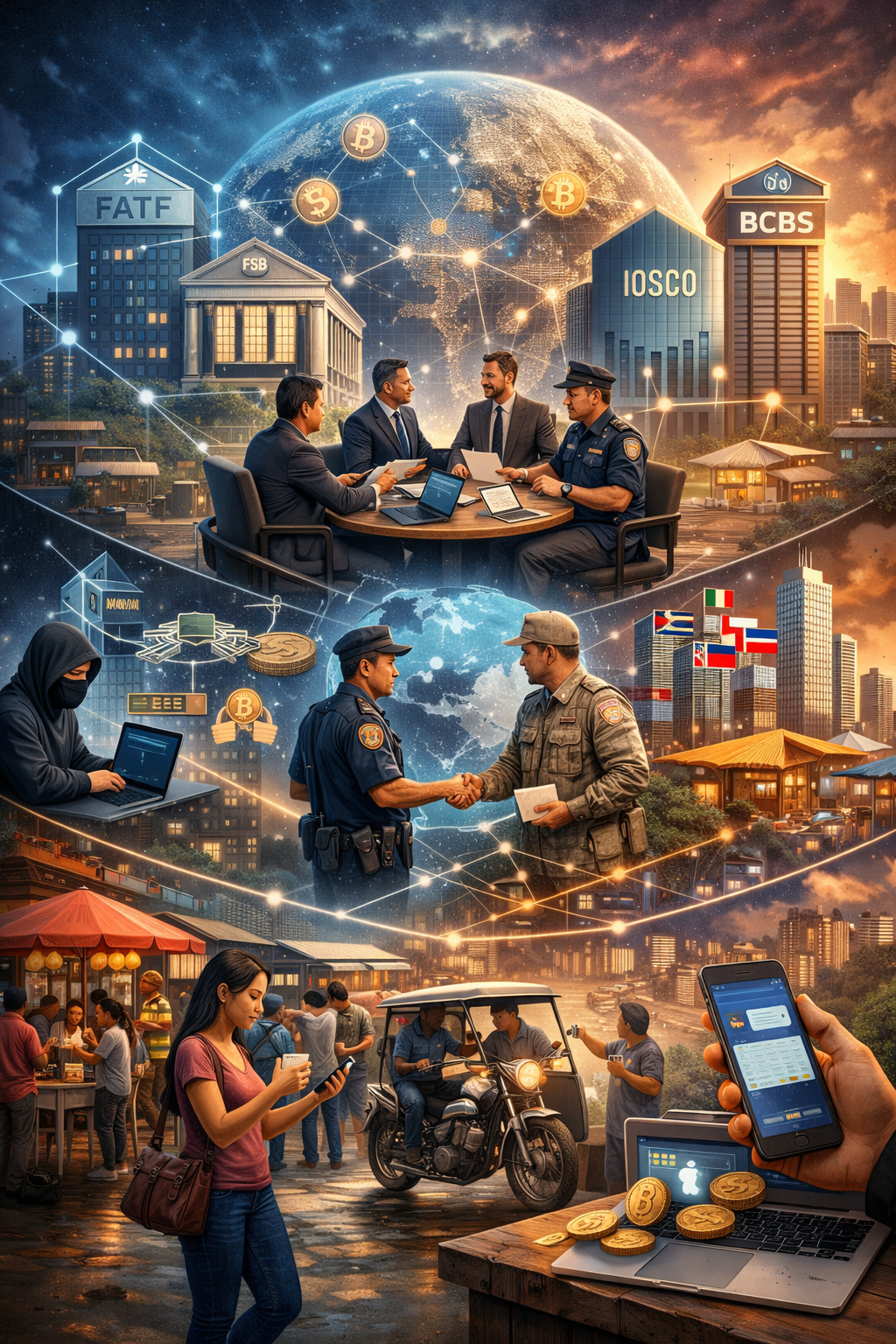
International coordination doesn’t usually produce a single universal law. Instead, it sets minimum expectations that countries implement through local licensing, supervision, and enforcement. Several global pillars shape that baseline:
- Financial Action Task Force (FATF) standards on anti-money laundering and counter-terrorist financing (AML/CFT), including the “Travel Rule” expectation that certain originator/beneficiary information accompanies virtual asset transfers.
- Financial Stability Board (FSB) work on systemic risk, governance, and cross-border consistency for crypto-asset activities that could threaten financial stability.
- IOSCO principles that influence market integrity, conflicts of interest, custody standards, and disclosure for platforms offering trading or investment products.
- Basel/BCBS prudential guidance affecting bank exposures to crypto, limiting risky balance-sheet accumulation.
The practical effect is convergence: even if definitions differ (token vs. security vs. commodity), regulators increasingly align on licensing of intermediaries, segregation of customer assets, fit-and-proper requirements, cybersecurity, and strong AML controls.
The Philippines as a real-economy testbed
The Philippines has an outsized relevance because it sits at the intersection of high retail adoption drivers and high policy sensitivity. It is a remittance-heavy economy with a large digitally connected population. That makes crypto attractive for cross-border transfers, micro-transactions, and mobile-first financial services—but it also amplifies the impact of scams, volatility, and unlicensed operators on everyday households.
Regulation in the Philippines tends to reflect a “pragmatic middle”: enabling innovation under clear rules while tightening controls where risks cluster. The Bangko Sentral ng Pilipinas (BSP) has established a framework for Virtual Asset Service Providers (VASPs)—covering licensing/registration, governance, risk management, and AML expectations for exchanges and similar intermediaries operating in or marketing to the country. In parallel, the Securities and Exchange Commission (SEC) applies securities-law concepts when tokens resemble investment contracts, while the Anti-Money Laundering Council (AMLC) drives compliance standards such as customer due diligence, suspicious transaction reporting, and cooperation with investigations.
How the Philippines contributes to global regulatory alignment
1) Implementing FATF expectations in a high-usage corridor
Because remittances and retail usage are central, the Philippines offers a “stress test” environment for AML/CFT controls and consumer protection. By requiring VASPs to operate under AML obligations and to cooperate with law enforcement requests, Philippine regulators help reinforce the global norm that crypto intermediaries are not outside the financial system’s compliance perimeter.
2) Cross-border enforcement and supervisory cooperation
International information-sharing is critical when fraud rings, mixers, or hacked funds move across jurisdictions. Philippine authorities’ ability to coordinate with foreign counterparts—through formal channels (mutual legal assistance, regulator MOUs) and operational collaboration—supports the broader global effort to reduce safe havens for unlicensed exchanges and scam networks.
3) Regional leadership through ASEAN and peer learning
The Philippines participates in regional dialogues where regulators compare licensing models, stablecoin approaches, and the handling of offshore platforms serving domestic users. This matters because consistency across neighboring markets reduces regulatory arbitrage and helps set shared expectations for consumer disclosures, advertising standards, and platform governance.
4) Policy design grounded in financial inclusion
Global frameworks can be overly focused on systemic institutions, but the Philippines brings a strong inclusion lens: how to protect small users, support responsible innovation, and integrate compliant crypto services with mainstream payment and banking rails. That perspective is increasingly relevant as international bodies discuss proportional regulation—strong controls without shutting out legitimate low-value use cases.
Key challenges and what to watch
The biggest ongoing tensions are familiar worldwide: regulating DeFi and self-custody without undermining privacy and innovation; dealing with offshore exchanges that target local users; and creating clear rules for stablecoins and tokenized investment products. The Philippines’ influence will likely grow as it continues refining supervision (cybersecurity, custody, proof-of-reserves practices), strengthening cross-border cooperation, and translating global standards into workable requirements for a retail, mobile-first market.