
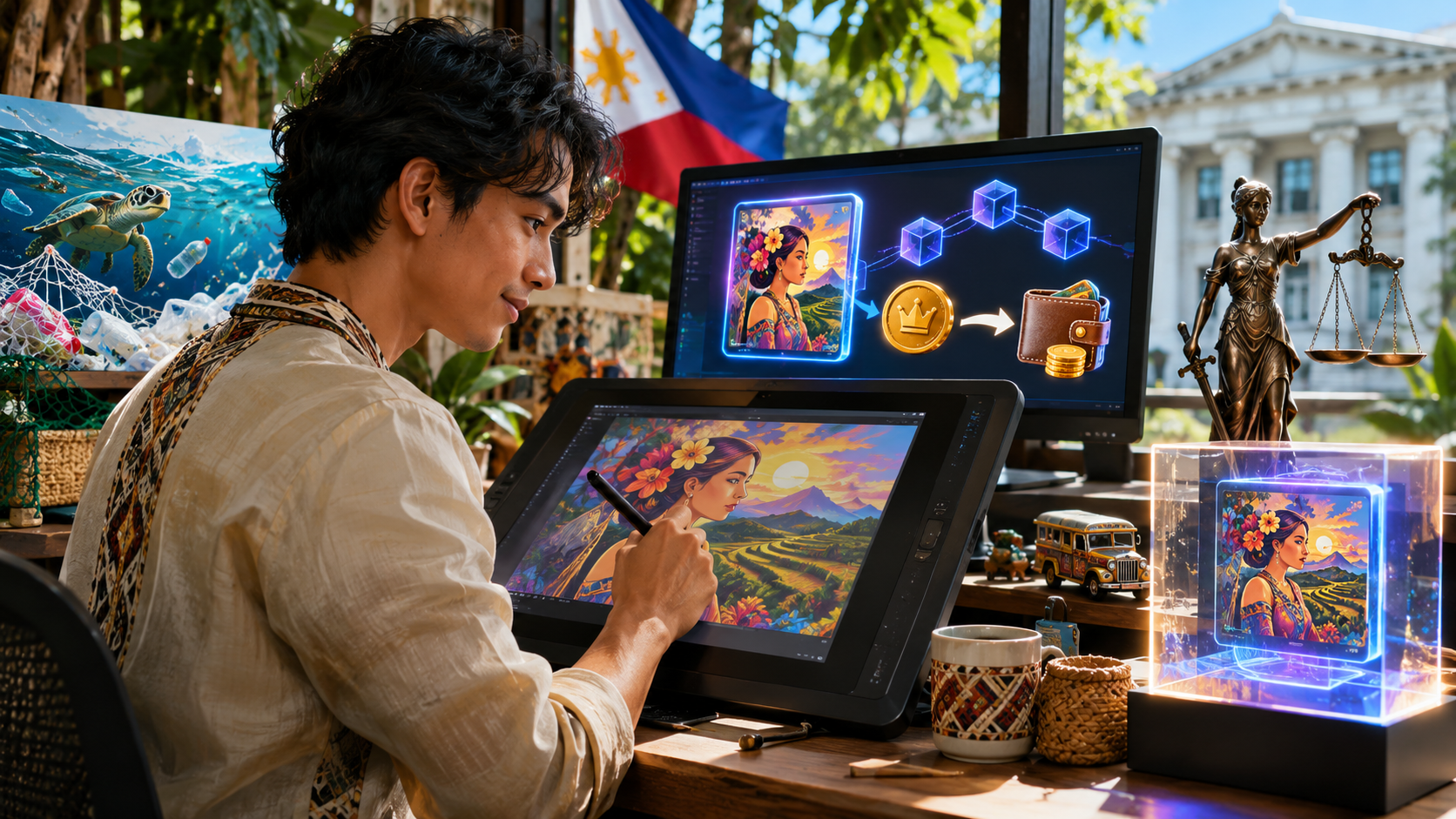
The promise of the NFT royalty—a perpetual commission paid to the original creator every time their work changes hands—has long been the most seductive pitch in Web3. For Filipino digital artists, animators, and illustrators, whose work often circulates globally through platforms that historically offered little recourse for secondary use, this mechanism represents something closer to economic sovereignty than a mere technological novelty. Yet in 2026, the Philippine NFT landscape sits at a tension point: the legal infrastructure is catching up, the technical enforcement is finally maturing, but the taxman is watching closely.
The Legal Groundwork: IPOPHL’s Push for Global Attribution
In April 2026, the Intellectual Property Office of the Philippines (IPOPHL) and the Department of Trade and Industry announced a partnership to expand Filipino creators’ access to a global identification system designed to improve attribution and royalty tracking across digital platforms . While the specific framework remains in development, the signal is unambiguous: the Philippine government recognizes that intellectual property in the digital realm requires infrastructure beyond traditional copyright registration.
For NFT creators, this matters profoundly. Royalties on secondary sales are only as reliable as the attribution system beneath them. Without a verifiable link between a wallet address and a real-world identity—or at least a persistent creator identifier—enforcing royalty payments across marketplaces becomes a game of whack-a-mole. IPOPHL’s move suggests that the Philippines is preparing to treat digital attribution as a trade and investment issue, not merely a legal curiosity.
Technical Enforcement: Why ERC-721C Changes the Calculus
The technical reality of NFT royalties has historically been messier than the marketing suggested. For years, marketplaces operated on an honor system. Creators set a royalty percentage—typically between 2.5% and 10%—and platforms like OpenSea or Blur could choose whether to honor it. Many did not. The result was a race to the bottom, with zero-fee marketplaces attracting volume by stripping creators of their secondary income .
The emergence of the ERC-721C standard, developed by blockchain gaming company Limit Break and adopted by OpenSea in 2024, changed the mechanics. ERC-721C allows creators to set enforceable transfer conditions directly into the token contract. If a sale occurs on a marketplace that does not honor the royalty, the transfer simply fails . This is not a perfect solution—it restricts the composability that makes NFTs useful in DeFi and gaming contexts—but for a Filipino visual artist whose primary concern is getting paid when their work is flipped, it represents a meaningful shift in bargaining power.
For creators in the Philippines, where access to legal recourse for cross-border IP infringement is limited by cost and jurisdiction, on-chain enforcement is not just convenient. It is often the only practical mechanism available.
The Tax Reality: Recurring Income, Recurring Obligations
Any discussion of recurring income in the Philippines must confront the Bureau of Internal Revenue. As of 2026, the BIR treats cryptocurrency—including NFTs—as digital property rather than legal tender. NFT sales and royalties are taxable events. The gains are subject to ordinary income tax rates ranging from 0% to 35%, depending on the creator’s total taxable income. The BIR generally accepts the First-In, First-Out method for calculating cost basis, and all values must be converted to Philippine pesos at the exchange rate prevailing on the transaction date .
Here is the friction point that many creators overlook: royalty income in cryptocurrency is taxed at the fair market value in PHP when received. If a creator earns 0.5 ETH in royalties in March and the price of ETH crashes by December, the tax obligation was already fixed at the March value. The volatility of crypto assets creates a tax liability that can exceed the realizable value of the holdings if creators are not disciplined about conversion.
There is no NFT-specific tax form. Royalty income must be reported as “other income” on standard BIR forms 1701 or 1700, with the annual deadline falling on April 15 . For creators accustomed to the informal, platform-mediated income streams of traditional freelance work, this represents a significant administrative shift.
Real-World Context: From Ocean Trash to On-Chain Assets
The abstract economics of royalties become concrete when viewed through specific Philippine projects. In 2026, Gate Charity collaborated with Filipino environmental artist Pedro Angco Jr.—known as JR—to transform ocean-collected waste into NFTs, with proceeds directed toward environmental awareness and community building. The collection, minted on Gate’s NFT platform, offered 500 NFTs at $10 USDT each, with the stated goal of funding local environmental initiatives .
While this particular project is charity-oriented rather than commercially driven, it illustrates a broader pattern: Filipino creators are experimenting with NFT mechanisms not merely for speculation but for community-funded, mission-aligned revenue. The royalty question in these contexts extends beyond individual profit—it becomes a question of whether digital assets can sustain ongoing public goods funding. If a collector resells an environmentally themed NFT at a premium, should the original artist and the cause they represent capture a share of that appreciation? The technology now allows for that answer to be yes. The legal and tax frameworks are still deciding how to account for it.
The Unresolved Tension: Enforcement Versus Composability
The Philippine NFT market’s growth trajectory through 2032 is projected to be driven partly by increasing recognition of NFTs as viable revenue streams for artists and creators . But the royalty model faces an inherent design tension that Filipino creators must understand. Strict enforcement mechanisms like ERC-721C protect royalties by restricting where and how NFTs can be transferred. That restriction limits the NFT’s utility in decentralized finance, gaming, and collateralized lending—the very use cases that could expand demand for a creator’s work beyond collectors .
A Filipino musician who mints a track as an NFT with strict royalty enforcement may earn reliably on secondary sales, but that same NFT cannot easily be used as collateral for a loan or integrated into a music-streaming dApp that requires transferability. The creator must choose between reliable rent extraction and broader ecosystem participation. There is no universally correct answer, but the choice should be made deliberately rather than by default.