
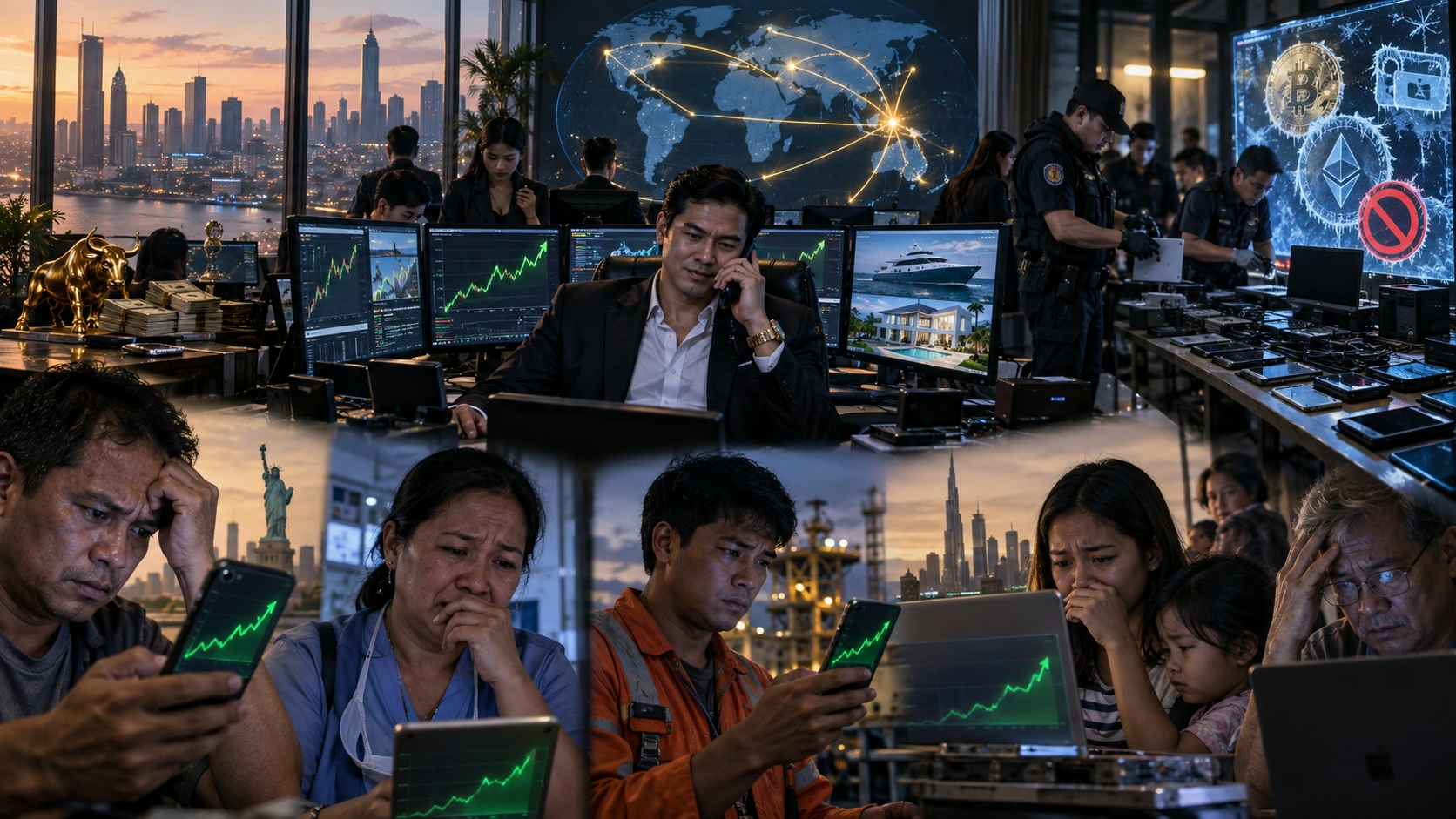
The Anatomy of a $150 Million Crypto Fraud in the Philippines
The Philippine Securities and Exchange Commission (SEC) issued a cease-and-desist order on May 20, 2026, against BG Wealth Sharing Ltd. and its founder, Stephen Beard, for operating an unregistered cryptocurrency copy-trading scheme that promised a daily compounded interest rate of 1.3% on a minimum investment of $500. The order, filed under SEC EIPD CDO Case No. 2026-0002, came after nearly a year of operation across multiple jurisdictions, including the United States, Samoa, and the Philippines. What regulators uncovered was not merely a compliance violation but a sprawling Ponzi scheme that on-chain investigator ZachXBT later estimated had extracted over $150 million from tens of thousands of victims across at least a dozen countries.
The scheme’s architecture was deliberately transnational. BG Wealth marketed itself through Facebook groups and messaging applications including WhatsApp, Telegram, Signal, and BonChat, presenting Beard as a “professor and investment guru” who ran “the world’s largest hedge fund”. Victims were funneled into the DSJ Exchange trading platform, where fabricated dashboards displayed unrealized gains of up to $1,500 for every $2,000 invested. In reality, all trading data was doctored, and investor funds were immediately siphoned into the operators’ bank accounts.
A Global Regulatory Blind Spot Exploited
The BG Wealth collapse exposed a critical gap in cross-border crypto enforcement. Thirteen regulators across five continents, including the UK’s Financial Conduct Authority, Australia’s ASIC, the Philippine SEC, and the Washington State Department of Financial Institutions, had issued public fraud warnings about the scheme before its collapse. The Washington DFI explicitly stated that neither BG Wealth nor DSJ Exchange had filed any registration forms with the US SEC despite claiming to be licensed.
Despite these warnings, the scheme continued to recruit victims, particularly targeting overseas Filipino workers (OFWs) who were persuaded that the business had been operating abroad since 2022. The SEC noted that BG Wealth continued to promote its investment scheme on social media even after a January 28, 2026 advisory warned the public not to invest.
The Pipeline Model: A New Scam Playbook
What distinguishes the BG Wealth case from earlier crypto frauds is the emergence of what investigators term the “scam pipeline.” In the days following the platform’s collapse, the same promoters who had recruited for BG Wealth began circulating new platform names, including Swift Wave Capital and HQI Exchange, within the same Telegram and BonChat groups where victims were gathering to discuss their losses. The dashboards on these new platforms are nearly identical, the recruitment scripts read the same, and the promised returns sit in the same suspicious 1% to 3% daily range.
This model treats the victim list as a reusable asset. Rather than disappearing after an exit scam, the operators redirect burned users into the next funnel, exploiting the trust and community infrastructure already established.
Enforcement and Asset Recovery
On April 23, 2026, US law enforcement seized one of BG Wealth’s domains as part of Operation Level Up and the Scam Center Strike Force. In the days that followed, the scammers laundered over $92 million in crypto assets across chains using token swaps, cross-chain bridges including Bridgers and Butter Network, and consolidation across hundreds of addresses. Tether ultimately froze $38.4 million in USDT on TRON on May 4, with an additional $3.1 million frozen at various exchanges, bringing the total recovered to approximately $41.5 million.
The Philippine SEC’s cease-and-desist order directs BG Wealth, its officers, representatives, and promoters to immediately cease operations, including the shutdown of their online presence. The order cites violations of the Securities Regulation Code and the Financial Products and Services Consumer Protection Act, applying the Howey Test to conclude that the scheme constituted an unregistered offering of investment contracts.
Broader Implications for Crypto Regulation in the Philippines
The BG Wealth case is not isolated. In the same period, Philippine authorities arrested the founder of Ploutos Coin, a separate crypto investment scheme that promised 40% returns in 10 days, on 22 warrants including 12 counts of syndicated estafa. The SEC also issued a cease-and-desist order against Riscoin, another copy-trading scheme operating through Telegram and Bonchat. In May 2026, the PNP Anti-Cybercrime Group arrested 63 individuals in a Pasig City raid targeting the XTrade platform, which was not registered with the SEC.
These cases collectively signal a regulatory pivot in the Philippines toward aggressive enforcement against unlicensed crypto-asset service providers. The SEC’s use of the Howey Test and the FCPA framework provides a legal template for treating crypto copy-trading schemes as securities fraud, potentially streamlining future prosecutions.