
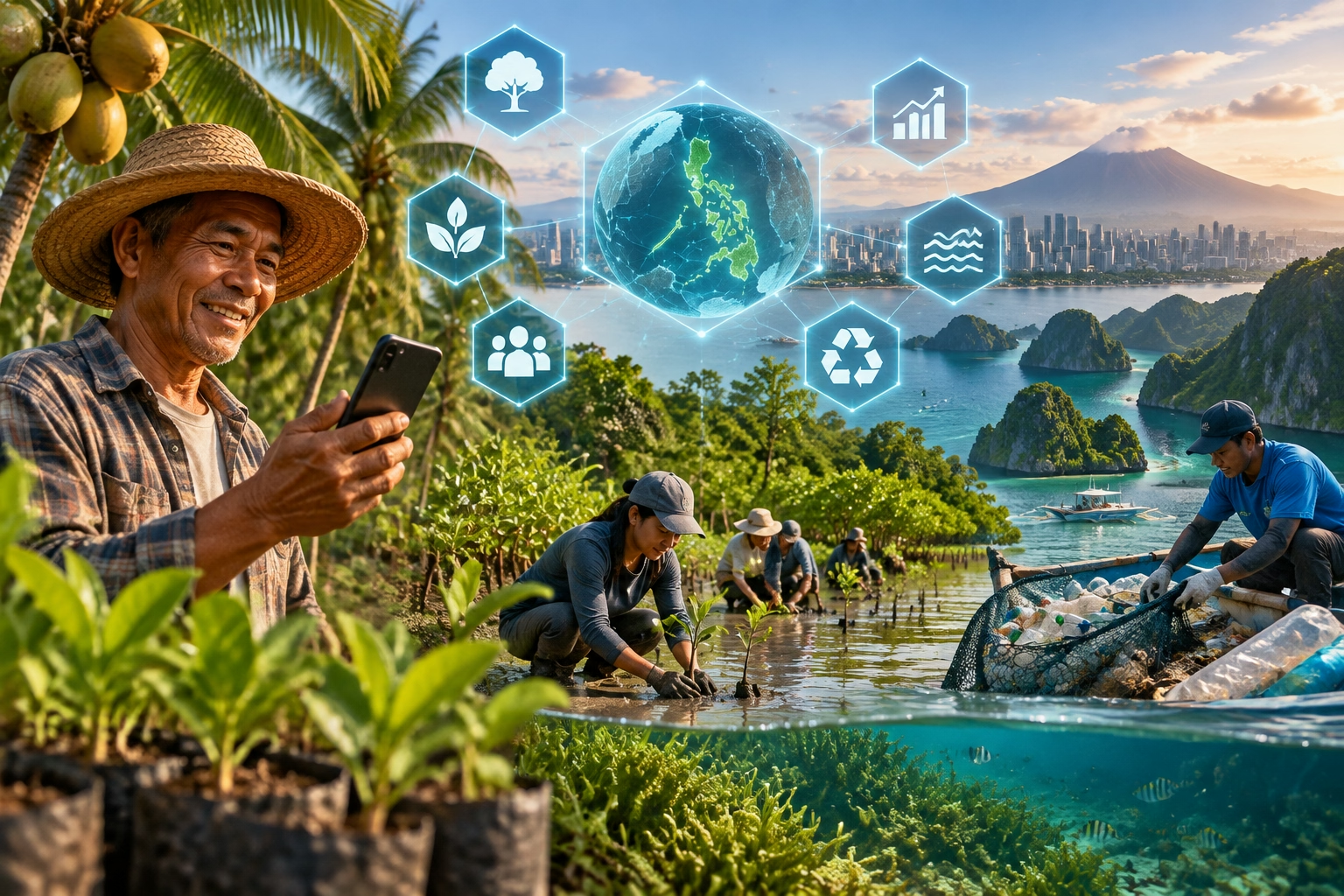
The Philippines, one of the world’s most climate-vulnerable nations, is quietly emerging as a testing ground for something unprecedented: using Web3 infrastructure to solve real environmental problems at national scale. In 2026, the country is no longer just a passive participant in global climate finance—it is building the rails.
The Digital Carbon Office: A Landmark Shift in Carbon Markets 2.0
In February 2026, at the World Economic Forum in Davos, the Confederation of Coconut Farmers Organizations of the Philippines (CONFED) and Swiss climate-tech firm EcoGuard Global AG signed an agreement to establish the Philippines’ first Digital Carbon Office, powered by a carbon financing and exchange platform built on the Hedera network.
The scale is staggering. CONFED represents over 3 million coconut farmers managing an estimated 540 million tonnes of CO₂e through regenerative agriculture across 3.6 million hectares. Under the agreement, EcoGuard plans to register 347 million coconut trees on its platform, enabling farmers to monetise carbon sequestration that has historically gone uncompensated.
What makes this different from previous carbon credit experiments is the infrastructure itself. The EcoGuard Platform digitises and automates the entire carbon asset lifecycle—from project registration and digital Monitoring, Reporting and Verification (dMRV) to issuance, trading, and retirement—ensuring full traceability for every credit. As Charles Avila, President of CONFED, put it: “When a farmer sequesters carbon, the financial incentives and rewards are delivered immediately and accurately rather than at the end of a multi-year cycle and after a significant value loss on account of administrative overheads, errors, and the cost of non-compliance”.
Targeted for deployment by June 2026, the platform supports international carbon credit trading under Article 6 of the Paris Agreement.
Beyond Carbon: Biodiversity, Blue Carbon, and Plastic Waste
The environmental Web3 movement in the Philippines extends well beyond carbon credits. GainForest, a non-profit leveraging the Filecoin network, is using blockchain to verify mangrove plantings and support indigenous communities, with active projects across Philippine ecosystems. In Palawan, the Garden Fleet initiative combines coastal plastic cleanup with mangrove reforestation, generating blockchain-linked “impact” records to verify environmental outcomes.
Plastic Bank has been operating in the Philippines since 2013, using blockchain to log every plastic collection transaction—weight, location, timestamp, and conversion into plastic credits—creating a transparent, tamper-proof reward system for informal waste collectors. The system integrates collectors through the Plastic Bank application, ensuring payments are traceable and accountable.
Meanwhile, Oceanus Conservation, founded by marine scientist Frances Camille Rivera, has been training local residents as citizen scientists using open-source data collection tools and blockchain to protect and restore blue carbon ecosystems in Mindanao.
The Verification Layer: Proof-of-Stake for Climate Data
A June 2026 study published in PLOS Climate demonstrated a proof-of-stake blockchain framework for transparent climate data verification, tested using 8,403 hours of temperature data from the Manila monitoring station during 2024. The framework detected 33 temperature anomalies aligned with documented heat waves, while consuming only approximately 0.06 kilowatt-hours—a 97–99 percent reduction compared with proof-of-work systems. This matters because trust in climate data remains a significant barrier to effective action; blockchain immutability combined with transparent statistical methods directly addresses this deficit.
What Lies Ahead
The DOST-Cordillera Administrative Region convened an exploratory meeting in Baguio City in March 2026 with EcoGuard Global and Telenym Philippines to align regional carbon credit projects with national and international climate goals. The convergence of government, Web3 infrastructure, and community-level participation suggests the Philippines is not merely adopting blockchain for environmental purposes—it is architecting a replicable model for climate-vulnerable nations worldwide.
The road ahead involves regulatory clarity and equitable value distribution, but the foundation is being laid in real time, on-chain, across millions of hectares and millions of farmers.