
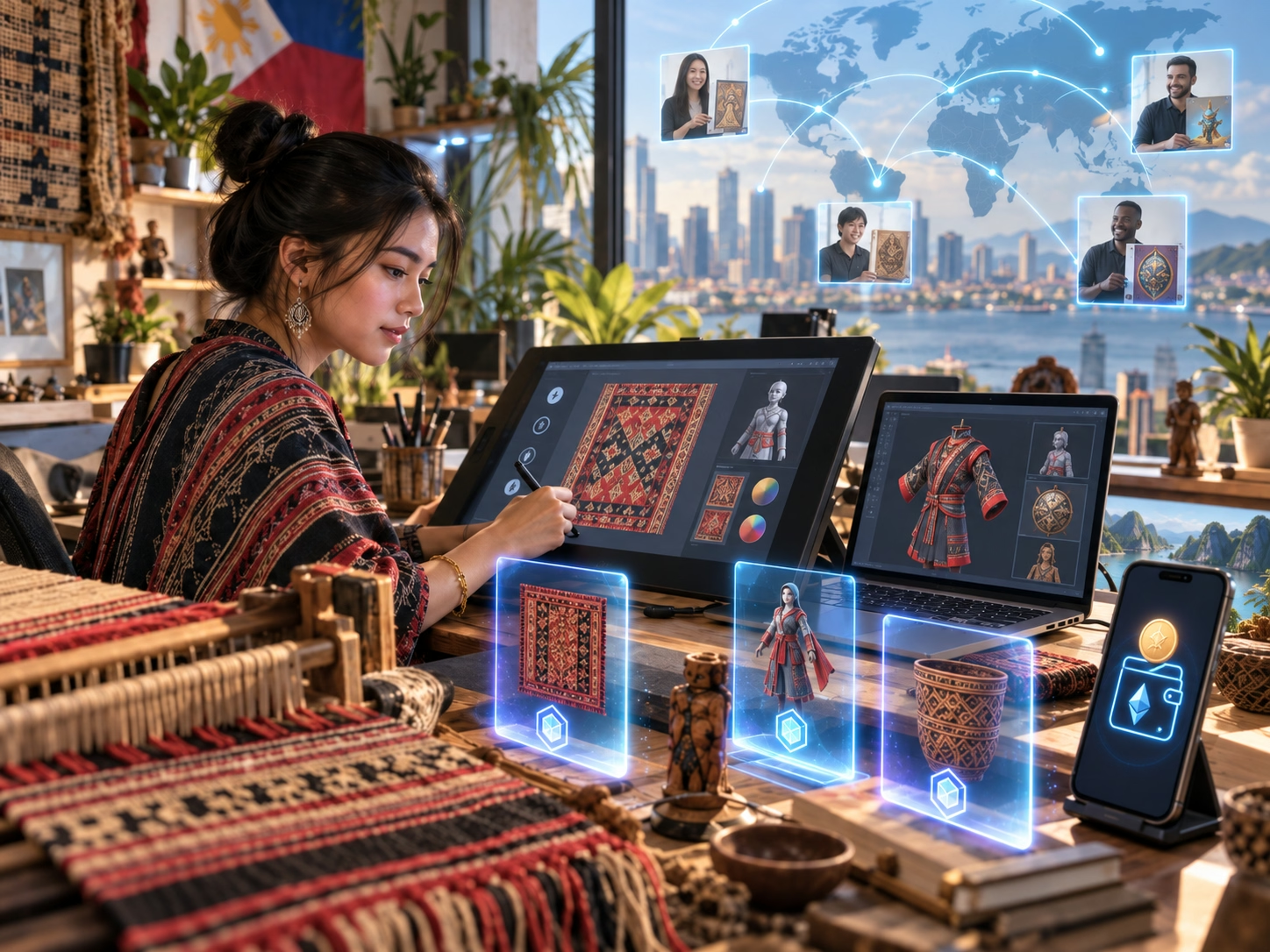
The creative economy of the Philippines has long been a powerhouse of raw talent, from the intricate weaves of the Cordilleras to the world-class animation studios of Manila. However, for decades, a significant barrier has stood between Filipino creators and the lucrative global market: logistics, payment rails, and the gatekeeping of Western galleries. By 2026, the maturation of Non-Fungible Tokens (NFTs) is not just changing the game; it is rewriting the rules of economic survival for the nation’s artists.
Breaking the Archaic Gallery and IP Gatekeeping Model
The traditional path to international recognition for a Filipino visual artist or game designer often required relocation to Singapore, Tokyo, or Los Angeles, or reliance on foreign licensing agencies that took disproportionate cuts. The economic reality of the Philippine Peso versus the US Dollar made this transition prohibitive for many.
In 2026, the narrative has shifted from speculative collectibles to utility-driven NFTs. Filipino creators are now utilizing blockchain technology as a digital passport and proof of ownership. By tokenizing their work, a graphic designer in Cebu can now sell a commercial license for a 3D asset directly to a game development studio in Sweden. The transaction settles in minutes, not weeks, and the smart contract ensures a royalty is automatically credited to the creator’s digital wallet every time that asset is resold or utilized in a commercial project. This disintermediation has effectively allowed Filipino talent to compete on merit and quality, rather than based on their physical location or access to international banking.
The Gaming and Entertainment Crossover: A Natural Habitat
The Philippines has one of the highest rates of mobile gaming penetration in Southeast Asia. This cultural familiarity with virtual economies has positioned Filipino developers and artists as natural leaders in the Web3 space.
The phenomenon of “Axie Infinity” may have introduced the country to crypto, but the 2026 landscape is more sophisticated. Filipino creators are moving beyond simple PFP (Profile Picture) projects and into interoperable metaverse assets. We are seeing the rise of “Play-to-Earn” models evolving into “Create-to-Earn” ecosystems. Local design studios are now securing grants from global blockchain foundations to build virtual fashion lines, architecture, and music scores that exist solely within popular metaverse platforms.
In this context, the NFT acts not just as art, but as code. A programmer in Davao can code a unique in-game weapon skin, tokenize it, and sell it to players globally without needing to pass through the strict publishing requirements of centralized app stores. This has opened a revenue stream that is often denominated in stablecoins, providing a hedge against local currency volatility.
Government and Private Sector Infrastructure in 2026
A major factor driving the success of Filipino NFTs in 2026 is the improvement of local infrastructure. The Department of Information and Communications Technology (DICT) and the Department of Trade and Industry (DTI) have shifted from a stance of caution to active regulation and support. They recognize the remittance potential of the digital asset sector.
Initiatives are underway to help MSMEs (Micro, Small, and Medium Enterprises) tokenize their intellectual property. For instance, the DTI’s 2026 roadmap emphasizes digital transformation for artisan communities. Rather than shipping physical goods (which often face high freight costs from the archipelago), local weavers in the Ilocos region are partnering with tech-savvy entrepreneurs to create “Phygital” assets. A buyer in Berlin can purchase an NFT that represents ownership of a unique, handwoven tapestry; the physical item is then held in secure storage or shipped at the buyer’s discretion, while the NFT can be traded or displayed in a virtual gallery. You can learn more about the government’s digital framework through the Philippine Development Plan 2023-2028 updates at https://pdp.neda.gov.ph/, which highlights the push for digitalization in creative sectors.
The Real-World Case: The “Ownly” Renaissance
To understand the Filipino NFT market in 2026, one must look at the evolution of homegrown platforms. Earlier in the decade, platforms like Ownly, a Filipino-founded NFT marketplace, struggled to gain traction against giants like OpenSea. However, by focusing on localized curation and Filipino heritage art, they have carved out a niche.
In late 2025 and into 2026, Ownly and similar platforms have begun integrating Layer-2 solutions that reduce minting fees to fractions of a cent. This is crucial for a market where the average minimum wage is significantly lower than in the West. The high gas fees of the Ethereum network previously locked out many young Filipino artists. Now, with low-cost chains and local platforms offering “lazy minting” (where the buyer pays the minting fee), the barrier to entry has vanished. A high school student in Quezon City can now upload a digital painting, set a 10% royalty, and sell it to a collector in New York without spending a single peso upfront.
The Diaspora Connection and Cultural Preservation
Another compelling angle for 2026 is the role of NFTs in connecting the 12 million-strong Filipino diaspora back to their roots. Overseas Filipino Workers (OFWs) and second-generation immigrants are using NFTs to engage with their heritage. Artists are tokenizing traditional music, indigenous scripts like Baybayin, and folklore illustrations. This creates a unique market dynamic where the demand is driven by emotional connection and cultural identity, rather than pure financial speculation. This has led to a surge in funding for cultural preservation projects, as the sale of a limited NFT series can fund the digitization of archives or the education of younger generations in traditional crafts.
Navigating the Road Ahead: Sustainability and Reputation
Despite the opportunities, Filipino artists are becoming acutely aware of the environmental and reputational risks associated with blockchain. The shift from Proof-of-Work to Proof-of-Stake blockchains has largely addressed the carbon footprint concerns that plagued NFTs in 2021. However, Filipino communities are emphasizing “trust” as a key component. Rug pulls and plagiarism within global NFT spaces have made buyers wary. Consequently, successful Filipino creators in 2026 are those who doxx themselves, build strong social media presences on TikTok and X (Twitter), and treat their collections as legitimate businesses rather than quick cash grabs.
The convergence of low-cost blockchain technology, a population fluent in digital interaction, and a global market hungry for authentic non-Western art styles positions the Philippines as a quiet superpower in the creative Web3 space. For Filipino artists, the NFT is no longer just a volatile token; it is the bridge that finally connects the islands to the world.