
The Philippines has long been considered the “proving ground” for the crypto world. While the global narrative around Web3 has shifted from speculative NFT flipping to utility-driven applications, the Southeast Asian archipelago remains the epicenter of a quiet revolution. As we look toward the latter half of the decade, the intersection of a young, tech-savvy population and a maturing blockchain infrastructure is creating a unique phenomenon: the evolution from “Play-to-Earn” (P2E) to “Play-and-Earn” (P&E) and beyond.
The question is no longer whether Filipinos will adopt Web3 gaming, but rather how the industry is transforming to accommodate a user base that demands sustainability over hype.
The Post-Axie Reality: A Maturing Market
To understand the current landscape of GameFi in the Philippines, one must first acknowledge the “Axie Infinity Era” of 2021. During the height of the COVID-19 pandemic, Axie Infinity became a lifeline for many, with some players earning more than the local minimum wage. However, the subsequent market crash taught the community a harsh lesson in tokenomics: inflationary reward models are unsustainable.
Fast forward to 2026, the survivors of that crash are building with a different ethos. According to a report by the Blockchain Game Alliance (BGA) and data from DappRadar, the Philippines remains the second-largest market globally for blockchain game adoption, driven by a shift toward “free-to-own” models. Gamers are no longer willing to pay thousands of pesos for a starter Axie; they expect the game to be fun first, with the earning potential as a secondary bonus.
The Rise of “Hyper-casual” and Mobile-First GameFi
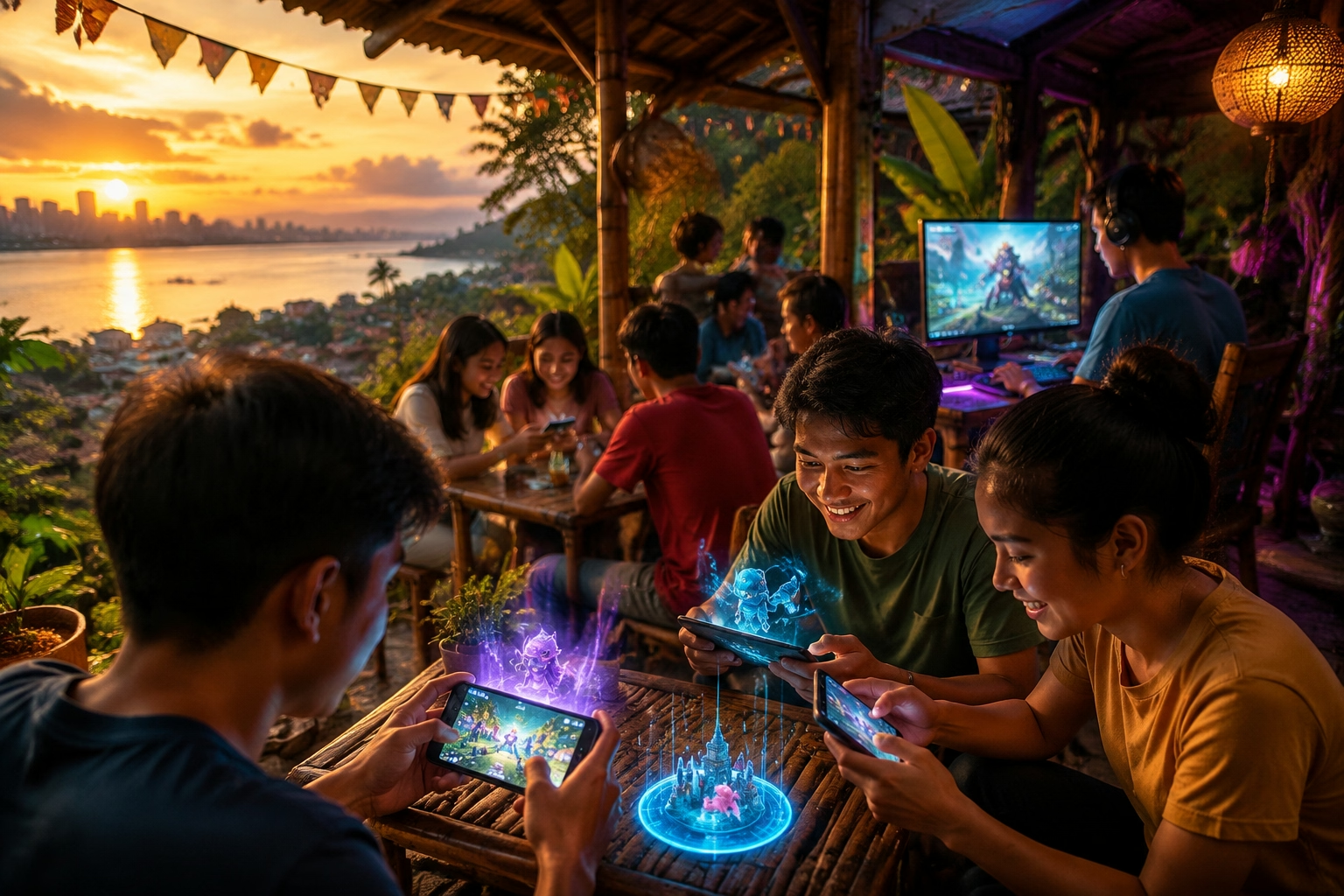
One of the most significant shifts in 2026 is the pivot away from complex, desktop-heavy MMORPGs toward hyper-casual and mid-core mobile games. The average Filipino gamer predominantly uses a mid-range Android device. Recognizing this, local developers and international studios are now prioritizing lightweight games that consume less data and battery, integrating crypto wallets seamlessly.
This aligns with the data provided in the 2026 Web3 Gaming Industry Report, which highlights that mobile-first GameFi projects in Southeast Asia have seen a 45% increase in daily active users compared to their desktop counterparts. This trend is crucial for a country where mobile data connectivity is vastly more prevalent than fiber-optic broadband in rural areas.
Integration of Local Payment Rails
A key factor driving this new wave is the integration of local financial infrastructure. Gone are the days of complicated MetaMask transactions for newcomers. In 2026, successful GameFi projects in the Philippines are leveraging platforms like GCash and Maya for direct fiat on-ramps and cash-outs. This seamlessness reduces the barrier to entry, allowing users to interact with blockchain assets (NFTs, tokens) without necessarily understanding the underlying code.
Beyond the Guilds: Community-Driven Economies
The scholarship model, where “managers” lend assets to “scholars” in exchange for a cut of the earnings, is undergoing a radical transformation. In the current climate, guilds are evolving into decentralized autonomous organizations (DAOs) that function more like gaming hubs or esports teams rather than labor brokers.
The Shift to Skill-Based Rewards
Instead of rewarding time spent grinding, modern GameFi protocols are implementing skill-based tournaments. A young gamer in Cebu or Davao can now enter a mobile legends-style Web3 tournament with a small entry fee paid in crypto, competing for prize pools funded by the game’s treasury rather than inflationary token emissions. This creates a sustainable circular economy where value is redistributed among players rather than extracted.
Regulatory Clarity: The Institutional Shift
The Philippine government’s stance has also matured. The Bangko Sentral ng Pilipinas (BSP) and the Securities and Exchange Commission (SEC) have moved from a position of warning against crypto to establishing clear guidelines for digital assets. This regulatory clarity has attracted significant foreign investment in the local Web3 gaming space.
In late 2025, the Philippine SEC finalized frameworks that categorize utility tokens used in games separately from securities, provided they have a clear use-case within the ecosystem. This legal certainty has allowed major gaming studios—previously hesitant due to compliance risks—to enter the market, bringing AAA-quality graphics and robust server infrastructure to the local GameFi scene.
A New Demographic: The Female Gamer and the Rural User
Contrary to the early days of Axie, which was heavily male-dominated and urban-centric, the 2026 demographic is diverse. Data suggests that female participation in GameFi in the Philippines has risen to nearly 40%, driven by games that incorporate fashion, simulation, and puzzle mechanics alongside DeFi elements. Furthermore, improved internet penetration in regions like Mindanao and the Visayas has turned these areas into hotbeds for new user acquisition, making GameFi a tool for financial inclusion beyond the capital region.
The narrative of Web3 gaming in the Philippines is no longer about “escaping poverty” through grinding; it is about digital ownership, community building, and entertainment. As the technology becomes invisible and the gameplay becomes the focal point, the Philippines is not just adopting GameFi—it is defining its next chapter for the rest of the world.